
The following items are covered in this update. If you have a question or comment for the Working Group, send it to dslpoaewm@gmail.com.
- EWM Dive Week 2026 Recap
- Identification and Monitoring
- The Barges are Both Afloat
- Control Measures – Day 1
- Control Measures – Day 2
- Control Measures – Day 3
- Watch For and Remove EWM Debris
- Early Assessment
- Looking Forward to Next Year
EWM Dive Week 2026 Recap
This year our diver assisted control activities took place from July 13 to 15 as planned. Despite some very hot weather and smoky air, the Working Group was able to direct benthic mat deployment (10,200 sq ft) at sites EWM1 and EWM4 and hand harvesting at sites EWM5, EWM6, EWM18 and EWM20. Growth at sites 1, 4 and 20 remains dense and these locations (Harris Beach, Bonham’s Bay and west Outlet Bay) will generate fragments over the summer and fall due to wave action, self fragmentation and boating activity. Since each fragment or floating plant with roots has the ability to create a new outbreak, immediate removal and disposal is essential.
The EWM drop down menu of the DSLPOA website contains information about EWM and our ongoing program. If you are new to Drag or Spruce Lake or need a refresher, spend a few minutes there. While you’re there you can also contribute to the EWM Fund. Thanks to last year’s 135 donors the fund is able to cover our expenses this year and we are now rebuilding the fund for next year. The 70 donors who have already made a donation in 2026 have added $20,000 to the fund. Special thanks to Tom M who demonstrated his family’s love of Drag Lake with a $5,000 donation.
Identification and Monitoring
As summer kicked off so did our whole lake effort to identify, monitor and selectively control the growth and spread of EWM in our two lakes. Many property owners helped by checking their own waterfront and removing EWM fragments for disposal away from the water. Many also looked in the water along their shore and around their docks. Some thought they had found EWM growth and emailed the Working Group at dslpoaewm@gmail.com for verification. This vigilant behaviour by all property owners is essential if we are to have an effective EWM identification element in our management program.
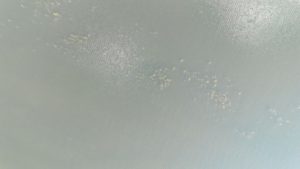
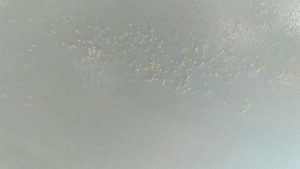
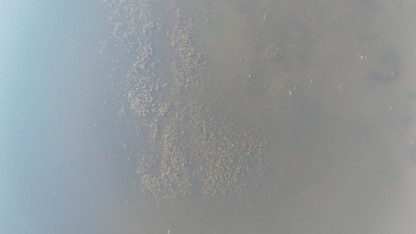
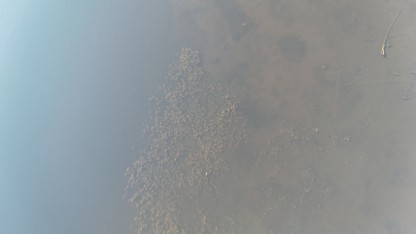
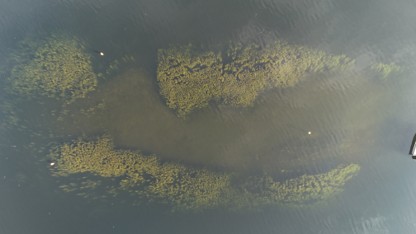
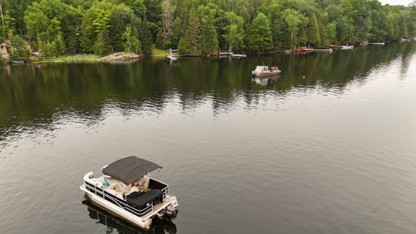
While everyone else was watching close to their own property the Working Group monitored growth at the 20 previously verified EWM sites to decide which sites would be on the list for diver assisted matting and/or hand harvesting this year. Priority is given to sites with the densest growth, sites very close to docks and sites presenting risk to watersport enthusiasts and motorboats. The following drone photos were taken at 150 feet overhead.
The Barges are Both Afloat
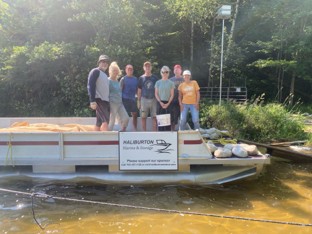
Thanks to some hard work by Jay Heaman and Bob Heyes and materials donated by Rod Sheridan, we have two seaworthy barges that served us well during matting activities. A little TLC every year under Jay’s guidance should keep them that way. This year we were fortunate to have in kind sponsorship from Haliburton Marine and Storage who loaned us a trailer to transfer the pontoon barge to and from the water. Jay and Bob are presently searching for a used trailer that will also be used for dry storage.
By the way, neither barge is self-loading. Even before the divers arrived a team of volunteers cut mats and then loaded mats and big rocks onto the barges. This process was repeated on Monday as needed to keep up with the divers. Dominique Binckly helped by arranging volunteers and by towing full and empty barges, as did Bob.
Control Measures – Day 1
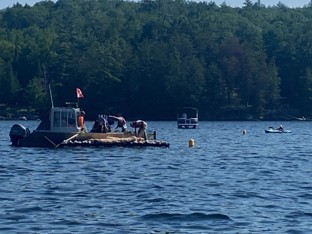
The commercial dive team met Bob Heyes at Sandy Cove and together picked up the first loaded supply barge from Harris Beach. On to site EWM1, just as the firm southerly wind arrived. Although the plan was to lay 12 mats, the persistent wind and height of the EWM plants (6-10 feet) meant the team could only deploy 8. During the day both barges were reloaded in preparation for use on Day 2. Although the divers’ day ended at 4:30, Bob then relocated both reloaded barges from Blueberry Island to Bonham’s Bay with help from Jane Heyes and Dominique. Thanks to the brave paddler/skimmers and the barge loaders.
Control Measures – Day 2
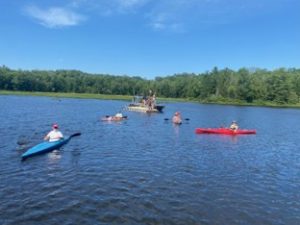
Two big differences from Day 1, the wind was not as strong and the EWM plants were shorter. As a result Bob, the divers and the volunteers successfully deployed 9 mats in Bonham’s Bay and hand harvested a few stems at nearby EWM6. Bob and the divers then hand harvested at EWM18 to end their day. Thanks to Dominique for retrieving an empty barge and returning it to Blueberry Island. Thanks as well to the volunteers for helping out on a hot, smoky day.
Control Measures – Day 3
Another early start with very different weather conditions – very little wind, overcast and much cooler. The extent of EWM20 is greater than observed last year, reinforcing our belief that it is important to apply control measures while an outbreak is “small”. Unfortunately, access to the area last August (lower water level) forced us to postpone our visit until this year. It is unlikely that all of the plants seen today will be harvested today. Unless the remaining plants mysteriously disappear over the winter, EWM20 will be on the priority list next year. This will give volunteers and donors in the immediate vicinity time to engage.
At 2:15 Bob and the dive team followed Jim through the 5 hazard buoys back to the deeper water of the big lake. After a quick stop at EWM5 in East Bay to harvest a few plants the dive team was on their way back to their base in Eastern Ontario. Their work is done, but Bob, Jim, Dominique, Jay, Allen, Rob, Martin and Rick will continue to monitor growth at all 20 sites and assess the impact of our 2026 matting and hand harvesting.
Watch For and Remove EWM Debris
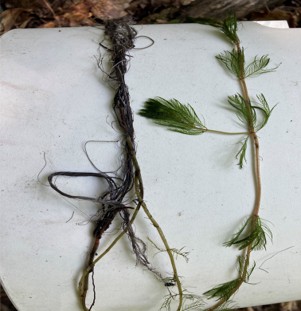
As a result of EWM hand harvesting in the west end of Outlet Bay, fragments or whole plants could arrive on your waterfront. The current will carry some towards the dam while the strong westerly wind will carry others in an easterly direction. Failure to remove fragments or floating plants from your waterfront can result in a new outbreak.
Early Assessment
Following last year’s monitoring the Working Group knew that sites EWM1 and EWM4 would contain dense growth, and we were correct. We did not anticipate the extent or density at site EWM20, but now know that this site will need regular diver assisted control measures as do EWM1 and EWM4. These three sites were the primary focus for the divers this year. All other sites with less extensive EWM growth have been “tuned up”, either by the divers or Bob with his long handled harvesting tool. The Working Group will continue over the summer to monitor all sites and provide a final report in the fall.
We cannot overstate the importance of all property owners watching for EWM plants and fragments and removing them from the water for disposal. Everyone can and must do this if our goal of sustainable control is to be achieved. We also cannot overstate the importance of avoiding driving boats through or fishing in EWM growth. Both of these activities are guaranteed to create fragments that can each be responsible for creating a new outbreak, maybe on your waterfront. We are all on this journey together and we depend on one another for a successful outcome.
Looking Forward to Next Year
We anticipate Dive Week costs next year to be between 8 and 10 thousand dollars per day and we will not plan for dive days unless the fund can pay for them. As reported in the Recap above, the first 70 donors this year have added $20,000 to the EWM Fund, enough to pay for just 2 days of dive services and materials. Based on this year’s monitoring and control, a program of 4 or 5 days with diver assistance may be needed to keep pace with EWM growth. As detailed above the program also depends on volunteers. If we do not see at least a doubling of contributions to the fund and additional volunteers willing to be active during Dive Week or in a leadership role as members of the Working Group, control activities may need to be targeted near those properties whose owners have contributed their dollars or their time. Unfortunately this program does not run without leadership or without your support. We are truly all in this together.
Submitted by Jim Miners for the Working Group (Bob, Jim, Jay, Dominique, Rob, Martin, Rick, Allen and Madeleine)
Photo credits – Bob and Jim
Drone photos – Jim